> For the complete documentation index, see [llms.txt](https://docs.radiusaas.com/llms.txt). Markdown versions of documentation pages are available by appending `.md` to page URLs; this page is available as [Markdown](https://docs.radiusaas.com/fr/configuration/access-point-setup/radsec-available.md).
# RadSec
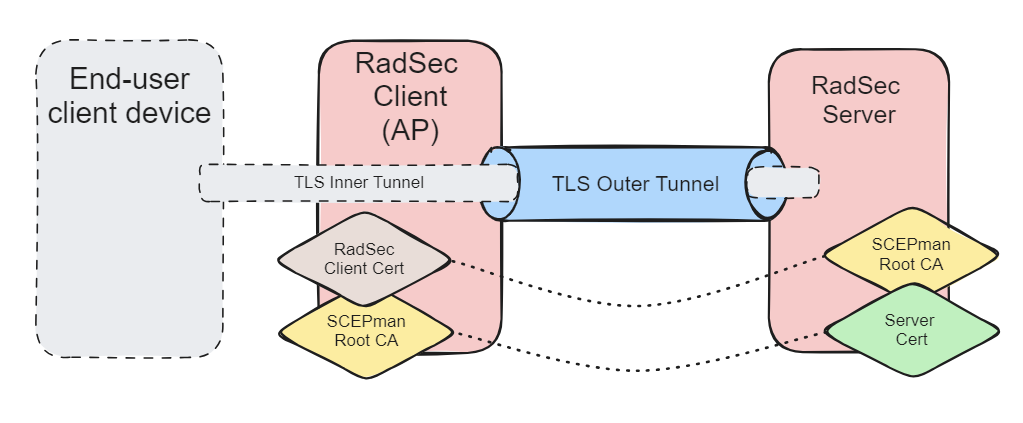
Affichage du tunnel externe TLS et des certificats requis
Avant que vos points d'accès puissent établir un **connexion RadSec** (ce qui peut être considéré comme une connexion mTLS), les exigences suivantes doivent être remplies, quel que soit le fabricant du point d'accès.
* Les points d'accès nécessitent un **certificat client** (généralement appelé « certificat client RadSec » ou « certificat RadSec »). Ce certificat client doit avoir l' **EKU Authentification du client** (1.3.6.1.5.5.7.3.2) et **pas Authentification du serveur**.
* Les points d'accès doivent **faire confiance à l'AC** qui a émis le **certificat serveur RADIUS**.
* RADIUSaaS doit **faire confiance à l'AC** qui a émis le **certificat client RadSec** sur vos points d'accès.
{% hint style="info" %}
Le protocole RadSec nécessite un secret partagé pour calculer les contrôles d'intégrité MD5.\
Le [RFC RadSec](https://datatracker.ietf.org/doc/html/rfc6614#:~:text=to%20implement\).%0A%0A%20%20%204.-,start,-exchanging%20RADIUS%20datagrams) définit ce secret partagé comme la chaîne littérale « radsec ».
{% endhint %}
{% content-ref url="/pages/67407186b55884ddc71444665d0b0b4de217598d" %}
[Aruba](/fr/configuration/access-point-setup/radsec-available/aruba.md)
{% endcontent-ref %}
{% content-ref url="/pages/4400ec4b22de95641bc22a19af3d9222ae73173f" %}
[FortiNet](/fr/configuration/access-point-setup/radsec-available/fortinet.md)
{% endcontent-ref %}
{% content-ref url="/pages/ed0c7f4128725dbea4829486d0ba6f5690021c98" %}
[Juniper Mist](/fr/configuration/access-point-setup/radsec-available/juniper-mist.md)
{% endcontent-ref %}
{% content-ref url="/pages/9b284d4e90a5c14137abbc6434f94da9c2c0f520" %}
[Meraki](/fr/configuration/access-point-setup/radsec-available/meraki.md)
{% endcontent-ref %}
{% content-ref url="/pages/c2fa59a9d78e9fb65f3e3e3b4407dfc91dce46c9" %}
[MikroTik](/fr/configuration/access-point-setup/radsec-available/mikrotik.md)
{% endcontent-ref %}
{% content-ref url="/pages/10e43154b212ad3f4d3e950c25c96d097c413506" %}
[Ruckus](/fr/configuration/access-point-setup/radsec-available/ruckus.md)
{% endcontent-ref %}
{% content-ref url="/pages/dad317c5f85fa731ea0caa7afebf6dc26a07a855" %}
[UniFi](/fr/configuration/access-point-setup/radsec-available/unifi.md)
{% endcontent-ref %}
---
# Agent Instructions
This documentation is published with GitBook. GitBook is the documentation platform designed so that both humans and AI agents can read, navigate, and reason over technical content effectively. Learn more at gitbook.com.
## Querying This Documentation
If you need additional information that is not directly available in this page, you can query the documentation by asking a question.
Perform an HTTP GET request on the following URL with the `ask` and `goal` query parameters:
```
GET https://docs.radiusaas.com/fr/configuration/access-point-setup/radsec-available.md?ask=&goal=
```
`ask` is the immediate question: it should be specific, self-contained, and written in natural language.
`goal` is what the user is ultimately trying to achieve, the reason they need the answer. Sharing it helps GitBook give you a better, more relevant answer. A goal is most helpful when it describes the outcome the user wants rather than restating the question. For example, with `ask=how do I create an API token`, a goal like `automate deployments from our CI pipeline` lets GitBook tailor the answer to that use case.
The response will contain a direct answer to the question and relevant excerpts and sources from the documentation.
Use this mechanism when the answer is not explicitly present in the current page, you need clarification or additional context, or you want to retrieve related documentation sections.