> For the complete documentation index, see [llms.txt](https://docs.radiusaas.com/llms.txt). Markdown versions of documentation pages are available by appending `.md` to page URLs; this page is available as [Markdown](https://docs.radiusaas.com/configuration/get-started.md).
# Getting Started
Our Getting Started Guides provide step-by-step instructions on how to configure RADIUSaaS for your environment.
## Checklist
Let's start with some essential questions:
* [ ] What PKI(s) are you using to issue the client authentication certificates?
* [ ] Shall device- or user-type client authentication certificates be used for authentication?
* [ ] Which MDM system are you using (e.g. Intune and/or Jamf Pro) and do you have access and rights to create device configuration profiles?
* [ ] Does your networking equipment support RadSec (RADIUS via TCP/TLS) and/or RADIUS (UDP)?
* [ ] Do you have access to the management portal of your networking gear?
* [ ] Do you have permissions in your Azure tenant to consent the Basic User Profile Read Access? This is needed to access your RADIUSaaS Portal.
## General Structure
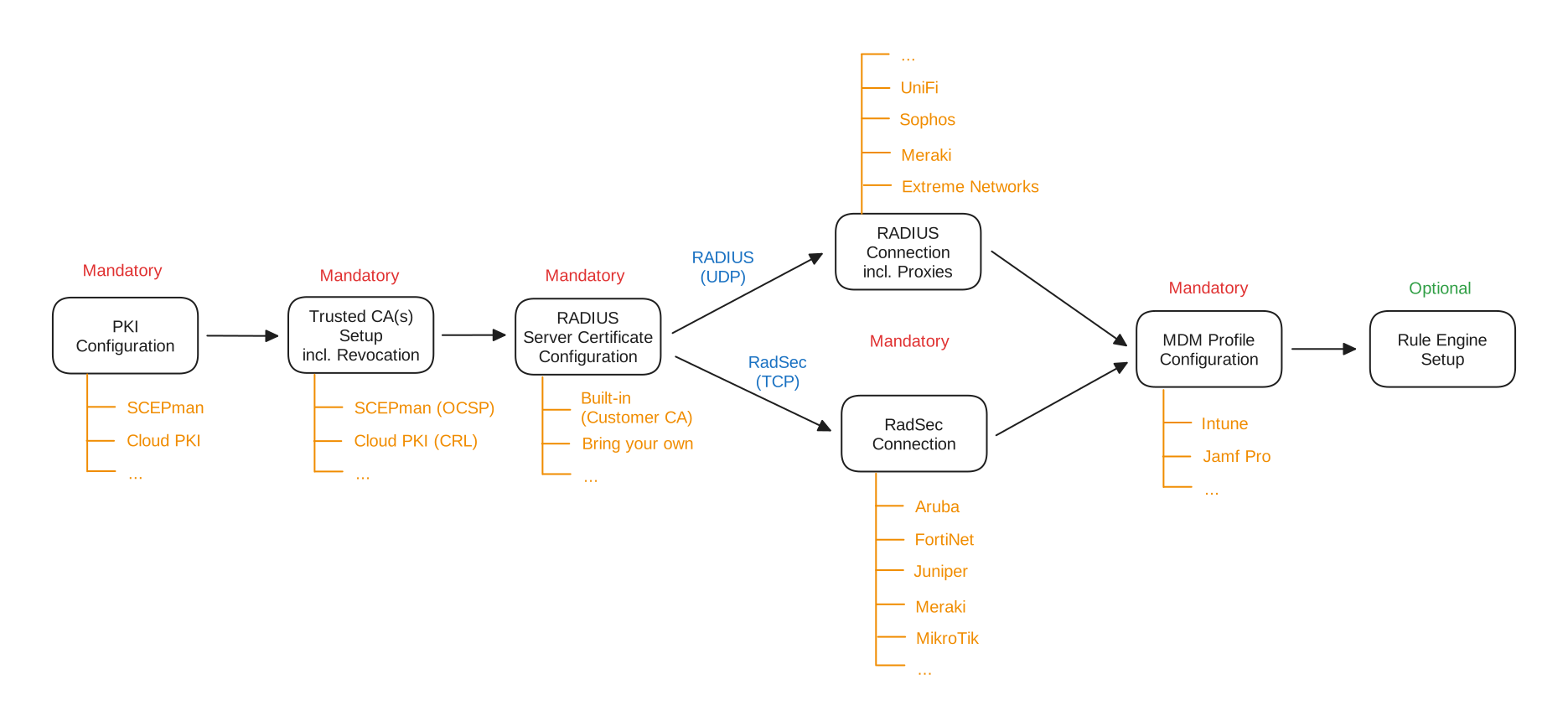
Below diagram details the generic setup procedure as explained in our guides below. The linear procedure forks depending on whether your network equipment supports **RadSec** natively **or** **RADIUS** only. Thus, in case you have requirements for both (e.g. due to a heterogeneous AP and/or switch fleet), both configurations must be completed.
Besides our [Generic Guide](/configuration/get-started/generic-guide.md), we have prepared [Scenario-based Guides](/configuration/get-started/scenario-based-guides.md) describing how RADIUSaaS can be configured for certificate-based WiFi authentication together with popular Cloud PKI solutions:
* RADIUSaaS with Microsoft Cloud PKI
* RADIUSaaS with SCEPman
 ## Generic Guide
{% content-ref url="/pages/0MMZ0wJtvDGDEMj8ImYb" %}
[Generic Guide](/configuration/get-started/generic-guide.md)
{% endcontent-ref %}
## Scenario-based Guides
{% content-ref url="/pages/fTVIdkrigRdMevtt8ck0" %}
[Microsoft Cloud PKI](/configuration/get-started/scenario-based-guides/microsoft-cloud-pki.md)
{% endcontent-ref %}
{% content-ref url="/pages/BwPUbviKnJuM9kP4ImWe" %}
[SCEPman Enterprise](/configuration/get-started/scenario-based-guides/scepman-enterprise.md)
{% endcontent-ref %}
---
# Agent Instructions
This documentation is published with GitBook. GitBook is the documentation platform designed so that both humans and AI agents can read, navigate, and reason over technical content effectively. Learn more at gitbook.com.
## Querying This Documentation
If you need additional information that is not directly available in this page, you can query the documentation by asking a question.
Perform an HTTP GET request on the following URL with the `ask` and `goal` query parameters:
```
GET https://docs.radiusaas.com/configuration/get-started.md?ask=&goal=
```
`ask` is the immediate question: it should be specific, self-contained, and written in natural language.
`goal` is what the user is ultimately trying to achieve, the reason they need the answer. Sharing it helps GitBook give you a better, more relevant answer. A goal is most helpful when it describes the outcome the user wants rather than restating the question. For example, with `ask=how do I create an API token`, a goal like `automate deployments from our CI pipeline` lets GitBook tailor the answer to that use case.
The response will contain a direct answer to the question and relevant excerpts and sources from the documentation.
Use this mechanism when the answer is not explicitly present in the current page, you need clarification or additional context, or you want to retrieve related documentation sections.
## Generic Guide
{% content-ref url="/pages/0MMZ0wJtvDGDEMj8ImYb" %}
[Generic Guide](/configuration/get-started/generic-guide.md)
{% endcontent-ref %}
## Scenario-based Guides
{% content-ref url="/pages/fTVIdkrigRdMevtt8ck0" %}
[Microsoft Cloud PKI](/configuration/get-started/scenario-based-guides/microsoft-cloud-pki.md)
{% endcontent-ref %}
{% content-ref url="/pages/BwPUbviKnJuM9kP4ImWe" %}
[SCEPman Enterprise](/configuration/get-started/scenario-based-guides/scepman-enterprise.md)
{% endcontent-ref %}
---
# Agent Instructions
This documentation is published with GitBook. GitBook is the documentation platform designed so that both humans and AI agents can read, navigate, and reason over technical content effectively. Learn more at gitbook.com.
## Querying This Documentation
If you need additional information that is not directly available in this page, you can query the documentation by asking a question.
Perform an HTTP GET request on the following URL with the `ask` and `goal` query parameters:
```
GET https://docs.radiusaas.com/configuration/get-started.md?ask=&goal=
```
`ask` is the immediate question: it should be specific, self-contained, and written in natural language.
`goal` is what the user is ultimately trying to achieve, the reason they need the answer. Sharing it helps GitBook give you a better, more relevant answer. A goal is most helpful when it describes the outcome the user wants rather than restating the question. For example, with `ask=how do I create an API token`, a goal like `automate deployments from our CI pipeline` lets GitBook tailor the answer to that use case.
The response will contain a direct answer to the question and relevant excerpts and sources from the documentation.
Use this mechanism when the answer is not explicitly present in the current page, you need clarification or additional context, or you want to retrieve related documentation sections.